Posted on
2025-11-10
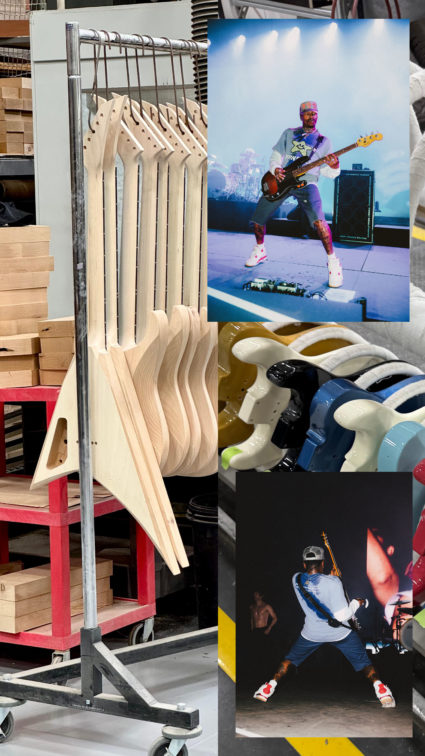
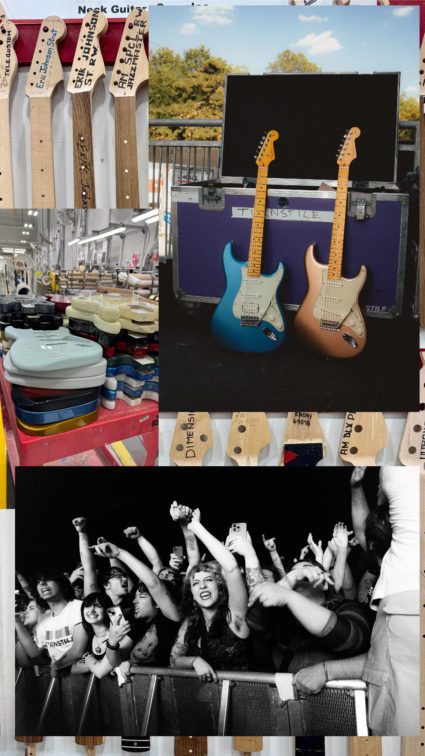
EXIT recently had the pleasure of visiting Los Angeles for the launch of the American Professional Classic, the latest evolution in Fender’s acclaimed American Professional series. A powerful continuation of the brand’s legacy, this recent addition further amplifies the defining voice of electric guitar craftsmanship. Our visit included an exclusive behind-the-scenes look at the meticulous, hand-crafted process that brings each Fender guitar to life at the legendary Fender factory in Corona, California. We also had the opportunity to sit down at the company’s Los Angeles headquarters with members of Fender’s product team, including Vice President of Fender Guitars and Amps Product Joey Brasler and Director of Product Allen Abbassi. Here’s what they shared with EXIT about the design process behind this new modern classic.
Allen Abbassi –
Aside from the tone, which is deeply rooted in Fender’s vintage DNA, these guitars also have a distinct look. The colours are incredible, they’re all vintage finishes from the ’50s and ’60s. Back then, Fender actually borrowed paint from car companies
and used the exact same automotive paints on their guitars. So, for example, ‘Lake Placid Blue’ was probably seen on a Ford back in the ’50s or ’60s. ‘Firemist Gold’ and ‘Sherwood Green Metallic’ are also classic car colours from that era.
With this new series, we’ve given those classic colours a fresh, exciting twist. They’re slightly faded, as if aged naturally over time, so they have a beautiful, worn-in character. For instance, this HSS Strat features a ‘Faded Black’ finish. Instead of a deep and glossy black, it’s a soft, charcoal hue. It’s really elegant and understated.
These guitars feature vintage-style hardware, vintage-voiced pickups and authentic colours that give you a true Fender experience.
The tone of these pickups is incredible, and there’s something for everyone in this series. We’ve got basses and electric guitars… our two main platforms are, of course, the Telecaster and the Stratocaster, the most popular Fender models. But our offset models – the Jazzmaster and the Jaguar – have also been gaining popularity steadily for the past twenty years. So, there’s truly a little something for every player: offsets, Strats, Teles, a Strat with a humbucker, and even a Tele with three pickups for added versatility.
On the bass side, we’ve got a traditional Precision Bass, a Jazz Bass, and a Mustang Bass – that’s the high-level overview. You can think of this series as the little brother to the American Professional line. ‘American Classic’ means it’s rooted in vintage Fender DNA, but the crowning jewels of these guitars are the necks: they feature a satin finish and a comfortable medium ‘C’ shape that we call ‘Modern C’. They’re extremely easy to play and have a flatter radius and larger frets, which makes getting around the neck smooth and effortless.
Joey Brasler –
The satin finish also prevents the sticky feeling you used to get from the old lacquer finishes on ’50s guitars. Even if your hands get sweaty, the neck stays smooth and fast. These are the kind of small improvements we’ve learned over the years that make a huge difference in playability. Even though the guitars look vintage, they play like a dream.
The tuners are Fender ClassicGear tuners, vintage in appearance but modern in performance – that was Al’s idea, by the way. They’re an 18:1 gear ratio, which means they turn slowly and precisely, making it much easier to dial in the exact note. On the old tuners, you’d go past the pitch and then have to come back… these eliminate that problem entirely. All of these thoughtful details make these guitars incredibly playable, reliable and fun. No fuss, no trouble, just great sound and feel. Traditional Telecasters come with two pickups, but the Hotshot Telecaster, for example, includes a middle pickup – like a Strat – for a wider tonal range. Again, we’ve made them look great, sound great and feel great. They’re also the most affordable American-made instruments you can buy – a true gateway into the U.S.-made Fender family. Simple, straightforward and true to Fender’s authentic roots.
Allen Abbassi –
You can literally grab one off the wall and go straight to a gig. The tonality of these instruments is wonderful. The pickups are based on our American Vintage II series – those are built exactly like we made them in the ’50s and ’60s – but these are slightly overwound, giving them just a touch more warmth and output. Players are going to love these guitars. They’ve got everything you need and nothing you don’t. No unnecessary bells and whistles, no locking tuners or complex switching systems. Just solid, authentic Fender craftsmanship.
EXIT’s Stephen Toner is in conversation with Fender’s President of the Americans Justin Norvell, discussing sound, design and the enduring spirit of the electric guitar.
ST: How has Fender’s role in music culture evolved over the decades?
JN: That’s a great question. It’s evolved by staying relevant, not resting on its laurels and also trying to guess a step ahead. The origin story of, you know, Buddy Holly and rock and roll, it didn’t stop there, things continued on. If you look at this campaign as it comes out, you know, with a band like Turnstile at the forefront of it… Fender is not a company that’s still just thinking about the 1950s. Our product line… we have digital floor modelling units. We’ve totally embraced how people use instruments these days. Our guitars can be plugged into interfaces on laptops – not just amplifiers – and people play with silent stages, all of that. We’re looking at that, but we’re also looking at new sounds and what’s motivating people to embrace and explore new genres. It’s not usually something that’s intentionally invented, but the more paint brushes or colours we put out there, the more somebody can grab one and do something with it. I think that over time, you know… distortion was not designed in the ‘60s to be a pleasing sound, but it became one, and genres were built off that. Tremolos were not supposed to be dive bombs, but that became a thing and people used that. Musicians always find an angle on something, you know? You have artists like Mk.gee today that are taking a regular guitar, making a baritone out of it, adding jazz strings and playing it into an old four track tape player that gives it a completely different sound. We’re always thinking, ‘what works right now?’. ‘What do people want? Quiet pickups? Loud pickups? Do people want to play with a lot of effects? Do people want options, or could they want something very simple that works very well?’. That’s why we have a very broad offering of things. But it’s really about the artist in the centre of it, and we’re always listening to ‘what’s now?’ and ‘what do we think is next?’.
What was the reasoning and decision-making behind Turnstile fronting the release?
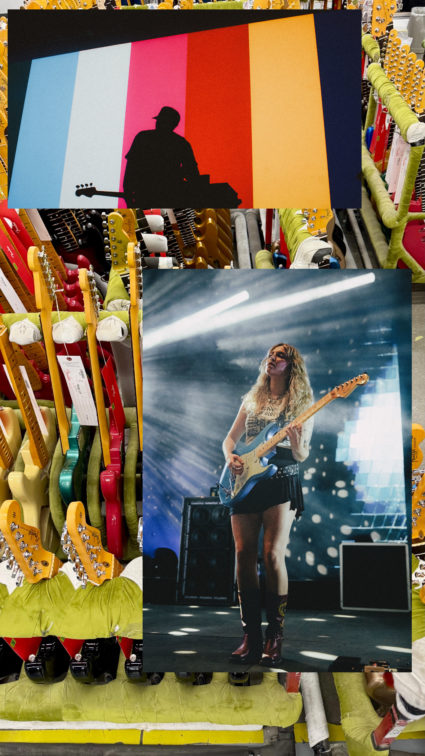
They’re a band that we’ve been working with already for multiple years. We felt it was a good moment, a good choice. There’re multiple players in the band who cover bass and guitars… it signifies a more forward lean compared to someone more classic, you know. It’s hyper relevant, so it just felt really good. Also, because it’s a little bit younger in mind, it’s more attuned to where this guitar line sits. It’s American-made, it’s the Corona, California guitars, but it’s also the entry point to those. It’s not, like, the top-of-the-top end, but it’s not an entry-level guitar.
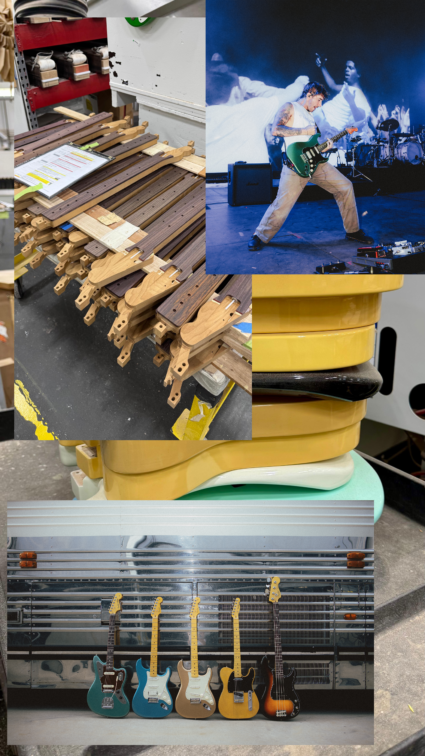
It was such a privilege to experience the hand-crafting of Fender guitars at the Corona factory, it truly felt like I was witnessing art and craft come together.
There’s a humanity that’s imbued into every instrument. Sonically, there’s a humanity in it. I think one of the reasons that Fender stays relevant is because our guitars sound like a Strat, but they also have this open space for you to sound like you, for that to come through. That means new music is always possible, because it hasn’t existed before, you know, as a new artist. That’s why they’re not just heavy metal guitars or jazz guitars. It’s this… anyone can play anything on a Fender. The handcrafting meeting the technological… all the math is there, all the geometry is perfect, then the whole thing gets just smoothed out and dialled in and built. I mean, one hundred and fifty hand processes, one hundred parts. It’s under tension, it’s wood… I mean, it really is fantastical. They kind of wake it up, you know? At the end, it all comes together. I’m almost in my thirtieth year at Fender, and I can still walk through the factory and just be, you know, gobsmacked.
What was your first guitar?
My first guitar was my father’s acoustic guitar that he wasn’t using. He taught me, like, three chords, the only three that he knew, and it sent me on my way. The Kinks, the Animals, those were kind of my first bands… Neil Young, that set me out on my path. I bought my first electric guitar whilst I was at grammar school in the UK. It was on a pin board, someone was selling their guitar. It was some no-name guitar. It didn’t play well, didn’t stay in tune, didn’t do anything I wanted it to do, but it planted the seed. I was a drummer first, but as I picked up the guitar it stayed with me very quickly. Fender and the Stratocaster just started sticking with me. I remember in the late ‘80s, when John Frusciante first joined the Chilli Peppers, I was just like, ‘I need to get a Stratocaster’. It just kind of beckoned to me. I was in a band, the guy who played a Stratocaster, that was just ‘it’ for me. Amazing, just visually, sonically… probably visually first, sonically second.
How do you think Fender’s legacy persists in the modern day?
I think it has ridden the wave across the ocean. Buddy Holly to Jimi Hendrix, punk rock to grunge, to new wave, to modern music, to the Strokes and the Arctic Monkeys… Fender is omnipresent, always there in the wings. Bands just continue to gravitate towards us. I think our cultural impact is such that… Keith Richards idolised Buddy Holly, so he chose Fender. Jeff Beck, Jimmy Page, those that came before you… the fact is, that lineage continues in what’s imprinted upon me – that’s what I’m going after. I can make it on my own, I can be individualistic about it, all the way
up through Billy Corgan, John Mayer… it just endures to this day.
Which guitarist has had the biggest influence on you?
Biggest influence would probably be Nile Rodgers, or Wayne Kramer from MC5. I was, like, a punk. I love punk music… Johnny Marr, too. Everybody’s like, ‘I listen to everything’… and it’s great to have one, I think those guys are at the centre of it. John Frusciante, as I mentioned before, when I was fifteen or sixteen years old… that’s taking Nile Rodgers to, like, another place. The Nile Rodgers thing is heavy in my point. Because I started as a drummer, it was percussive… guitarists that really play with a lot of rhythm and percussion, that’s really something that appeals to me
personally.
How does the American Professional Classic honour Leo Fender’s original vision?
It honours his original vision by keeping an honest and strong through line to his designs whilst continually updating and changing things. If you look at a ‘54 Strat, it was an ash body, a ‘U’ neck, it had different pickups, different knobs. By ‘57, it was a ‘V’ neck, an alder body, a different sunburst… the parts had all changed. By ‘59, it was a rosewood fingerboard. That iterative tweaking is just the Leo Fender recipe. Everything that’s great about it isn’t ruined, we’re not sawing the horn off. We’re just continually dialling in, changing and finding. Guitar players are always wanting new tools, new sounds, new inspiration. People say, ‘there are songs in this guitar’. You could pick up another one and just go… you’re inspired, and three songs fall out. That’s what we’re looking for.
fender.com