DAVE HEATH – MULTITUDE, SOLITUDE

Posted on 2016-01-25

From a crowd gathered in Central Park to solitary figures lost in thought, Dave Heath’s images conjure feelings of alienation and a desire for human connection. Multitude, Solitude highlights the photographer’s black-and-white pictures of the 1950s and 1960s, an intense period of self-discovery and innovation for the artist. During these pivotal years, Heath developed groundbreaking approaches to narrative and image sequence, producing exquisite individual prints, handmade book maquettes, his poetic masterwork, A Dialogue with Solitude, and multimedia slide presentations. His sensitive explorations of loss, pain, love, and hope reveal Heath to be one of the most original photographers of those decades.
This exhibition is the first comprehensive survey of Heath’s deeply personal early work. Abandoned by both his parents by the age of four, Heath lived in Philadelphia foster homes and in an orphanage until the age of sixteen. The turmoil of his childhood profoundly shaped Heath and his artistic vision. Just before his sixteenth birthday, he encountered a poignant photo-essay about foster care in Life magazine, and became intrigued by photography’s potential to transcend simple reportage. Almost entirely self-taught, Heath channeled his feelings of abandonment into a body of work that underscores the importance and difficulties of human contact and interaction. Multitude, Solitude reaffirms Heath’s status as a key figure in twentieth-century photography and highlights his deeply empathetic sensibility.

Opposite – Berkeley, California, 1964

Exhibition runs through till February 16th, 2016

The Philadelphia Museum of Art
2600 Benjamin Franklin Parkway
Philadelphia
PA
19130

www.philamuseum.org


DR.DAIN L. TASKER – FLORAL STUDIES

Posted on 2016-01-25

Dr. Tasker was the chief radiologist at Wilshire Hospital in Los Angeles when radiology was in its formative phase. In the late 1920’s inspired by his knowledge of the x-ray image process, and through his developing involvement with Pictorial photography, Dr. Tasker began to record numerous varieties of flowers with the x-ray process.

His results are among the most striking and unique floral images in the history of photography, delicate in their rendering of subtle tones and descriptive in the tracing of the flower’s fragile structure; fulfilling with out sentimentality, Tasker’s statement, “Flowers are the expression of the love life of plants”.

Tasker’s floral x-ray photographs, created in the 1930’s are timeless representations of their subject drawn by a distinct process that marries science and art, situating themselves as forerunners within certain experimental modes of contemporary photographic practice. Dr. Tasker’s modest, yet fully realized radiographs of flowers include a range of species and a wealth of structural beauty that is both inherent to their subject and an effect of the artist’s arrangement within the rectangular field that holds their form.

Opposite – Fuchsia, 1938

Exhibition runs through till February 19th, 2016

Joseph Bellows Gallery
7661 Girard Avenue
La Jolla
CA
92037

www.josephbellows.com


ROSALIND FOX SOLOMON – GOT TO GO

Posted on 2016-01-25

Part memoir and part fiction, Got To Go presents a collection of photographs from across Rosalind Fox Solomon’s life, contrasting a narrative of her own early years with other, urgent images that reveal a wider vision of the world, one outside of the rigid boundaries imposed by society and the home. If biography is a net cast upon us by family and shaped by social codes, Fox Solomon lays bare the limits of the net, as she negotiates the cusp between lived life and her imagination. Describing the work as a “tragicomedy”, full of both humour and pathos, Fox Solomon probes the limits we impose on ourselves, not only social codes but also the inherited tenets which are so difficult to escape.

Got to Go, Rosalind Fox Solomon’s fourth solo exhibition with the gallery, will include 27 pictures of varied sizes, as well as an audio-visual installation including approximately 40 images. The sound component includes excerpts from Jason Eckardt’s piece, Tongues, performed by Tony Arnold, soprano, and the International Contemporary Ensemble live at Roulette; a funeral chant; and Fox Solomon’s audio texts.

Fox Solomon, an American artist based in New York City, is celebrated for her portraits and connection to human suffering, ritual, survival and struggle. Her work has been shown in nearly 30 solo exhibitions and 100 group exhibitions, and is in the collections of over 50 museums worldwide.
Opposite – Tennessee, 1976

Exhibition runs from February 25th to April 16th, 2016

Bruce Silverstein
535 West 24th Street
New York
NY
10011

www.brucesilverstein.com


MASAHISA FUKASE – SOLITUDE OF RAVENS

Posted on 2016-01-18

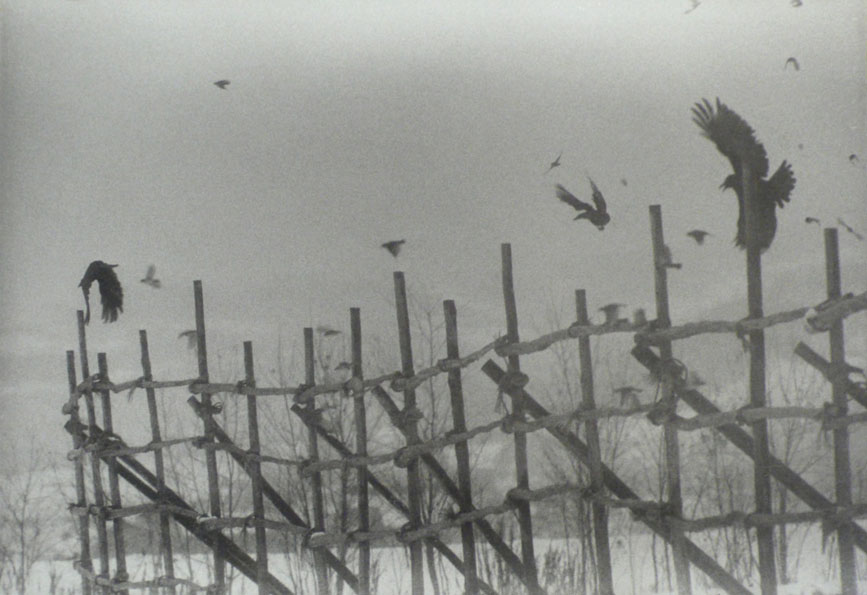
Masahisa Fukase’s Karasu (Ravens) was made between 1976 and 1982 in the wake of his wife Yōko Wanibe divorcing him. The visual narrative of the series revolves around the anthropomorphic form of the raven. Dead and alive the birds punctuate the work; lone birds reduced to shadow puppetry against the snow or dislocated flocks that mimic the grain of the photographs themselves. Although interjected with other subjects such as blizzard streaked streets or the fleshy form of a nude masseuse, it is the recurrent presence of the ravens that sets the ominous and cinematic tone of the work.

Akira Hasegawa in her poetic afterword to the book summarises Ravens with the following: “In the case of Masahisa Fukase, the subject of his gaze became the raven. For him, the “raven” was both a tangible creature and a fitting symbol of his own solitude”. At the end of the project in 1982 Fukase himself enigmatically wrote that he had “become a raven”.

Opposite – Nayoro, 1977

Exhibition runs from February 24th to April 23rd, 2016

Michael Hoppen Gallery
3 Jubilee Place
London
SW3 3TD

www.michaelhoppengallery.com


HAMBURGER EYES – CYBERNETICS

Posted on 2016-01-18

Hamburger Eyes “CYBERNETICS” is a retrospective photography exhibition celebrating 15 years of independent publishing. On display will be 500+ photographs ranging from 8″ x 10″ to4’ x 6’. All exclusively selected for this prolific show.

CYBERNETICS is the scientific study of control and communication in animals and in machines. It seeks to develop general theories of communication within complex systems, whether those systems be mechanical, physical, cognitive, biological or social. Cybernetics is a meta-theory that is relevant when what is being observed incorporates a closed-signaling loop, in other words, where action by the observed generates some change in its environment and that change is reflected in that system in some manner that triggers a change.

Friedrich von Schiller, wrote in “Letters on the Aesthetic Education of Man, 1795”

The transition from a suffering state of sensuality towards an intellectual activity, will not happen except through a middle state of aesthetic freedom. … There is no other way to make the rational part of our mind sensible, without being illustrated in a previous state of aesthetic energy.

Opposite – Michael Hernandez

Exhibition runs through till February 28th, 2016

Slow Culture Gallery
943 N. Hill St
Los Angeles
CA 90012

www.slowculture.com


BARBARA PROBST

Posted on 2016-01-18

Probst sets up multiple cameras and uses a radio-controlled shutter release in order to capture a single moment. In each of the new works, a central narrative is present but elusive and the purposeful actions in her earlier works give way to the introspection of a distracted camera. Not all of the cameras share the same interest and the images reveal an autonomous gaze.

In Exposure #115 and Exposure #116 some of the cameras are fixed on an interior space: a sleeping woman, cocooned by the city around her, a draped shawl, a figure gazing out onto the world, her lips gently parted as though she were about to speak out. Others aim towards the city rooftops, a looming tower under construction, and steam rising into a gray sky.

Observation takes on a new meaning as the pensive lens reveals a subjectivity, while seemingly pointed in no particular direction. In the impressive twelve-part Exposure #114, the focus is not solely on a seated model, but also the assemblage of photographic equipment and a green bottle atop a table. The stark angularity of tripods and synchronizing devices, the soft curves of the model’s body, and the gentle reflections in the green glass, are glimpses of a moment that asks to be stitched back together. All of the elements take on a fractured but cohesive personality and the viewer is called upon to imagine the connections and fill in the gaps. In fact, the viewer’s experience is even more essential to these new works as it occupies the same space as the subjective camera. As in film, the camera shows us a distinct point of view through which we try to understand a multifaceted scene.

Opposite – Exposure #116: N.Y.C., 428 Broome Street, 04.10.15, 1:11 p.m., 2015

Exhibition runs through till February 20th, 2016

Murray Guy
453 West 17th Street
New York
10011

murrayguy.comr