SEBASTIAO SALGADO – GENESIS

Posted on 2014-12-08

Genesis is the third long-term series on global issues by world-renowned photographer Sebastião Salgado (born Brazil, 1944), following Workers (1993) and Migrations (2000). The result of an eight-year worldwide survey, the exhibition draws together more than 200 spectacular black-and-white photographs of wildlife, landscapes, seascapes, and indigenous peoples—raising public awareness about the pressing issues of environment and climate change.

Exhibition runs through till January 11th, 2015

International Center of Photography
1133 Avenue of the Americas at 43rd Street
New York
NY
10036

www.icp.org


SIRI KAUR – THIS KIND OF FACE

Posted on 2014-12-08

The works on view are selected from an ongoing series Kaur started in 2006 to capture impersonators who spend much of their daily life as costumed celebrity look-alikes. Kaur initially set out to photograph the moment when the subject of a photograph lets down their guard and cracks appear in the everyday performance of the idea of self. Impersonators offer an exaggerated instance of this schism, representing conflict on the surface of their bodies in the uncomfortable conflation of their everyday existence with the aggrandized construction they attempt to embody. We see the impersonator in an ordinary, natural habitat: Cyndi Lauper on a motel mattress, Abe Lincoln in a Southern California backyard.

As we look closely at the subjects of Kaur’s photographs we see people who are not quite living out fantasies of being the rich and famous. Rather, they are look-alikes in the business of being a doppelganger, providing a tangible vessel for the audience’s already media-saturated imagination. Like her subjects, who fashion themselves after specific glamorized Hollywood and media constructions, Kaur found herself over the course of the project impersonating the production of celebrity photographers such as Richard Avedon and Bruce Weber. The formal structures of her photographs morphed as she expanded the scope of her practice. She imitated Hollywood industry headshots and US Weekly paparazzo pictures, and created her own 4×5 photographic versions of Warhol’s Marilyns and dictators. In other images, mundane moments reveal themselves, rendered both poignant and uncanny by Kaur’s formal eye: Superman talking on the telephone, Saddam Hussein cracking a smile, Marilyn Monroe shyly crossing her hands together. Together the pictures in This Kind of Face function as playful hybridic references to the multiplicity of possibilities existing within the expansive field of photographic portraiture.

Opposite – Siri Kaur, Marilyn (Wink), 2014

Exhibition runs through till December 23rd, 2014

Cohen Gallery
7354 Beverly Boulevard
Los Angeles
CA 90036

www.stephencohengallery.com


BRUCE DAVIDSON IN COLOUR

Posted on 2014-12-01

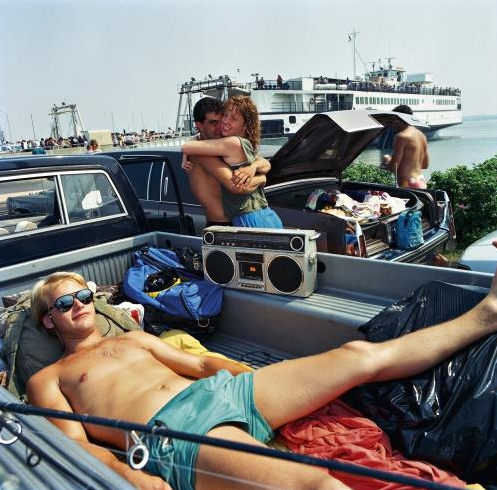
This exhibition coincides with the release of the new monograph from Steidl Bruce Davidson In Color.
Ranging from a period of fifty-six years and counting, these images are representative of the photographer’s color career. Assignments from various magazines (Vogue, National Geographic, Life magazine) and commercial projects led him to photograph fashion (early 1960s), the Shah of Iran with his family (1964), keepers of French monuments (1988), the supermodel Kylie Bax (1997), and college cheerleaders (1989). He photographed in India and China, but also at home in New York, in Chicago, and along the Pacific Coast Highway. In 1968, Michelangelo Antonioni invited him to document the making of his film Zabriskie Point. Davidson also continued to pursue personal projects, e.g. photographing the Yiddish writer and Nobel Prize laureate Isaac Bashevis Singer (1972–75), the New York City subway (1980), and Katz’s Delicatessen (2004).

Opposite – Martha´s Vineyard, 1979-88

Exhibition runs through to December 6th, 2014

Howard Greenberg Gallery
The Fuller Building
41 East 57 Street
Suite 1406
New York
NY 10022

www.howardgreenberg.com


JOACHIM BROHM – VERNACULAR & MODERN

Posted on 2014-12-01

This London-based solo exhibition records an ongoing concern with the notion of architecture as an environment for recreation, in a new body of work that contrasts the modernism of Ludwig Mies van der Rohe with Brohm’s study of vernacular German allotment buildings of the late 1970s, Typology.

Over 80 years ago, German-American architect Mies van der Rohe took part in a competition to design a club house for the newly founded Krefeld Golf Club, although due to the Great Depression, the house was never built. In 2013, Mies’ design was finally put into practice under the artistic directorship of Belgian architect Paul Robbrecht, using a model built according to the original plans.
Joachim Brohm spent time photographing this temporary model and created a body of work entitled Mies Model Study consisting of both colour and black and white images. Fascinated with the rough nature of some parts of the structure as a contemporary interpretation of the incomplete Mies sketches, Brohm’s images gracefully reference the aesthetic language of modernist architectural photography of the 20th century.
Typology 1979 is the retrospective title Brohm gave to a series of photographs taken while studying at the Folkwang Hochschule in Essen, using muted tones to document vernacular German allotment huts in muted tones and colours. The series is devoted to recreational places and the activities of people living in the artist’s immediate area around the industrial Ruhr.

Exhibition runs through to January 10th, 2015

Grimaldi Gavin
27 Albemarle Street
London
W1S 4DW

www.grimaldigavin.com


CONFLICT, TIME, PHOTOGAPHY

Posted on 2014-12-01

From the seconds after a bomb is detonated to a former scene of battle years after a war has ended, this moving exhibition focuses on the passing of time, tracing a diverse and poignant journey through over 150 years of conflict around the world, since the invention of photography.

In an innovative move, the works are ordered according to how long after the event they were created from moments, days and weeks to decades later. Photographs taken seven months after the fire bombing of Dresden are shown alongside those taken seven months after the end of the First Gulf War. Images made in Vietnam 25 years after the fall of Saigon are shown alongside those made in Nakasaki 25 years after the atomic bomb. The result is the chance to make never-before-made connections while viewing the legacy of war as artists and photographers have captured it in retrospect.

The immediate trauma of war can be seen in the eyes of Don McCullin’s Shell-shocked US Marine 1968, while the destruction of buildings and landscapes are documented by Simon Norfolk’s Afghanistan: Chronotopia 2001.
Different conflicts will also reappear from multiple points in time throughout the exhibition. The Second World War for example is addressed in Jerzy Lewczynski’s 1960 photographs of the Wolf’s Lair / Adolf Hitler’s War Headquarters, Shomei Tomatsu’s images of objects found in Nagasaki, Kikuji Kawada’s epic project The Map made in Hiroshima in the 1960s, Michael Schmidt’s Berlin streetscapes from 1980 and Nick Waplington’s 1993 close-ups of cell walls from a Prisoner of War camp in Wales.

Opposite – Richard Peter, Dresden After Allied Raids Germany 1945

Exhibition runs through to March 15th, 2015

Tate Modern
Bankside
London
SE1 9TG

www.howardgreenberg.com


HIROSHI SUGIMOTO – STILL LIFE

Posted on 2014-11-24

Capturing large-scale dioramas inside natural history museums, Sugimoto’s photographs initially seem to be documents of the natural world, featuring far-flung landscapes and wildlife. Sugimoto, however, dwells in the artifice of the images. Composed in crisp black and white and sharp tones, the pristine quality and stillness of these large-scale pieces reveal the inherent artificiality of the constructed worlds contained within their frames.

Surveying his Diorama series, the exhibition highlights recurring themes and images that have sustained Sugimoto’s interest and work for almost four decades. Some of the works on view from 1980 were recently printed for the first time, and some images from 1974 and 1994 are exhibited in larger sizes than their initial printings.

The earliest works on view in the exhibition are dated to 1976, when Sugimoto first moved to New York and visited the American Museum of Natural History. “The first time I saw a diorama I was overwhelmed by the fragility of existence that it captured. Being models of nature, dioramas include many of the world’s constituent parts,” Sugimoto wrote. “The only thing absent is life itself. Time comes to a halt and never-ending stillness reigns.” The works both breathe new life into the natural scenes, conjuring a false sense of reality, while highlighting their lifelessness.

Opposite – Olympic Rainforest, 2012

Exhibition runs through to January 24th, 2015

Pace Gallery
6 Burlington Gardens
London
W1S 3ET

www.pacegallery.com