AITOR ORTIZ

Posted on 2016-02-22

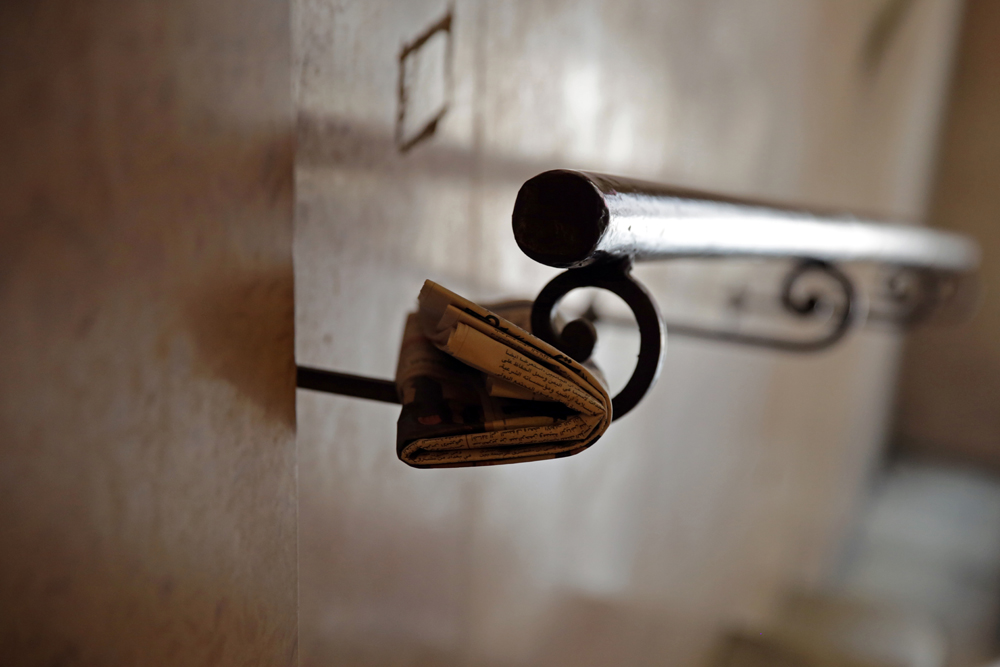
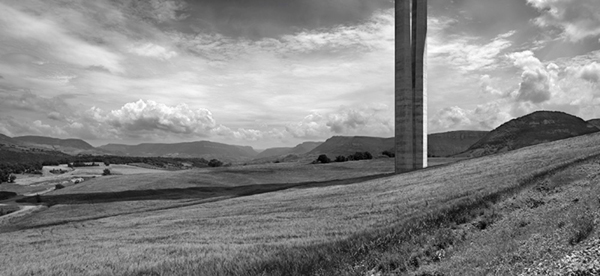
Beyond the documental photography of architecture, and asserting the dilution factor and transmutation of reality that is associated with photographic representation, Aitor Ortiz works with space, architecture and objects as opening elements to introduce a number of visual and cognitive unknowns.

His interest persistently raises a series of dilemmas between representation and interpretation (perception) while establishing a relationship between the content of his images, the physical properties of the materials on which he reproduces his works and their physical position in an exhibition. That’s why Aitor Ortiz is trying to establish a broad spectrum of work process and a relationships between photographed places, the conscious and unconscious mechanisms involved in the process of image manipulation: the eye (interpretation, frame, contextualisation, …), the camera (focus / blur, optical distortion, motion transmission, …), and the brain (the limitations of an imperfect device in the interpretation of data and empirical skills: experience, association of concepts ..) that culminate in the exhibition space; where physical experience again transcends the content of his photographs as part of a process of constant interaction between their representation and the viewer’s perception.

Opposite – Millau 007, 2008

Exhibition runs through till May 1st, 2016

Galerie Springer Berlin
Fasanenstrasse 13
10623 Berlin
Germany
www.galeriespringer.de


OLIVO BARBERI – ADRIATIC SEA (STAGED) DANCING PEOPLE

Posted on 2016-02-22

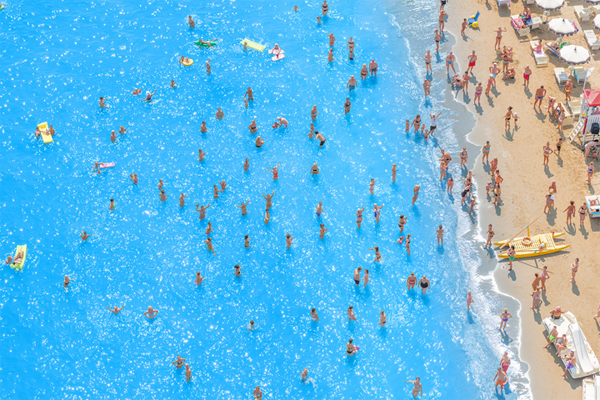
In August 2015, while creating LA CITTA PERFETTA (The Perfect City), a new film commissioned by MAXXI, Rome, and exhibited concurrently with the artist’s mid-career retrospective Immagini 1978-2014, Barbieri once again chose a helicopter as his main platform from which to shoot. While traversing 400 kilometers along the coast from Vasto to Ravenna, Barbieri discovered groups of people standing in shallow water in distinct and unlikely arrangements, performing what appeared to be a joyful ritualistic dance led by instructors.

The historic Adriatic coastline presents a continuous stretch of industrial, commercial, residential, and recreational activity. A mix of affluent urban living, tourism, congestion and environmental waste, Barbieri sees the area as a “perfect” example of the complexity and paradox of contemporary urbanization. He describes the dancing figures on the beach as “a manifestation of the genius loci of those places where folk dance is extremely popular and historically regarded by the old and new generations and where still the big disco clubs stand like cathedrals in the desert.”

Barbieri envisioned the shoreline and sea as a film or stage set where people on vacation dance to imaginary choreography, isolated against a digitally created blue heightened by the artist to suggest the blue of one’s imagination when remembering a day at the beach. The resulting photographs evoke both the ritualistic joyfulness of Matisse’s figures in the painting La Danse and stills from a Technicolor Busby Berkeley film. In addition, Barbieri has created ghost like twins of the photographs where the same dancing figures are reduced to simple white silhouettes, like in an architectural rendering, becoming simultaneously more comprehensible yet more enigmatic.

Opposite – Adriatic Sea (Staged) Dancing People 8, 2015

Exhibition runs through till March 19th, 2016

Yancey Richardson Gallery
525 West 22nd Street
New York
NY 10011

elevenfineart.com


RANDA SHAATH – INDELIBLE

Posted on 2016-02-22

Randa Shaath is known for her lucid black and white photographs that document the daily life of Cairo residents, and the rapid transformations that the city has witnessed over the last decade or so. In her latest exhibition entitled “Indelible”, Shaath asks: when does one feel at home? Shaath explores this question through a suite of more than forty colour photographs that she has been working on for the last two years. She takes her camera inside the homes of family and friends and acknowledges ordinary and familiar objects, moments, and spaces that we often overlook, granting them a grace that evokes the people that breath life into them.

Light and shadow animate objects and spaces alike. Images are shot with a natural light that induces a soft atmospheric mood: brightness seeping through the slats of traditional wooden shutters, a flowery shadow of an iron grill cast against a yellowing wall, a dancing reflection of the sun bouncing off shiny white bathroom tiles. Many of the images resemble 19th century realist paintings in their depictions of everyday life, and in the interplay between darkness and light.

In her photographs, time does not stand still. Time is channeled in the movement of light. It is experienced in the worn out furniture, in the peeling walls, and in the leftovers of our daily life. Shaath is adept at creating resonating images from the most mundane objects with a subtle sense of humor can be gleaned in her choices. In one image, two table fans just sit side by side covered with see-through plastic bags. They at once speak of heat, dust and the desire to preserve. They also speak of the intensely visceral life in Egypt.

Opposite – Untitled (Indelible), 2016

Exhibition runs through till April 5th, 2016

Gypsum Gallery
5 Ibrahim Naguib Street, Apt 2
Garden City
Cairo
Egypt

gypsumgallery.com


NORMAN PARKINSON – ELEGANCE IN VOGUE

Posted on 2016-02-15

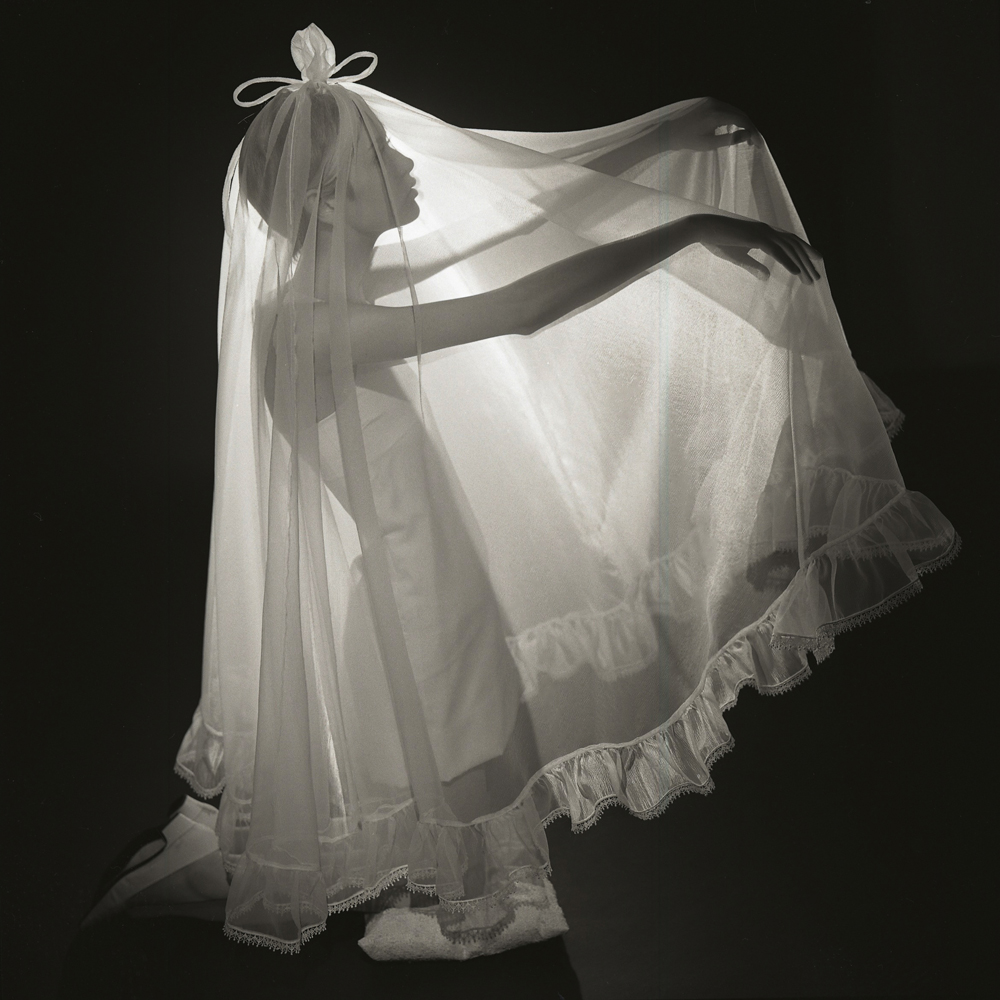
In a career that spanned over five decades, Norman Parkinson photographed for Vogue for most of this time. He worked consistently for ‘British Vogue’ from 1941 to 1960, and after a stint at Queen, returned again in 1965 working with ‘British Vogue’ through 1975. His long association with ‘Vogue’ brought him worldwide recognition and he is now considered one of the twentieth century’s foremost fashion photographers.

Parkinson was instrumental in taking fashion photography beyond the stiff formality of his predecessors and injecting an easy and casual elegance into his images. His impulsive and unstructured style changed forever the static, posed approach to fashion photography.

Norman Parkinson dazzled the world with his sparkling inventiveness as a fashion photographer and his work provides a comprehensive and unique record of the development of fashion design, photography and modelling from the 1940’s to 1990.

Opposite – White Weddings (Twiggy), British Vogue, February 1967

Exhibition runs through till March 24th, 2016

Eleven
11 Eccleston Street
London
SW1W 9LX

elevenfineart.com


ROBERT HEINECKEN

Posted on 2016-02-15

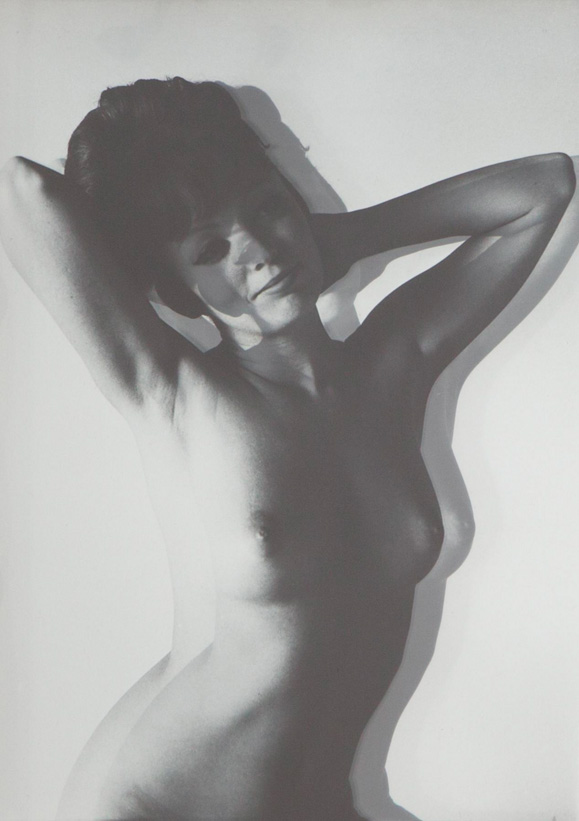
Robert Heinecken (1931 – 2006) is widely considered a significant forerunner of appropriation art. A self-described ‘para-photographer’, Heinecken was interested in how mass-media was processed and consumed (or, alternately, how mass media processed and consumed its viewers with its “manufactured experience”). He was indebted to the Surrealist idea of chance and automatism as well as Barthes’ critique of photographic indexicality. Both influences run through the exhibition’s “Figure in Six Sections” (1965) a rare “exquisite corpse” stacked sculpture in which a silver gelatin print of the back of a standing nude has been adhered to each of the four sides of an 8 ½” tall wooden cube cut into six layers, similar in structure to a rubix cube. The layers, which rotate on an axis, can theoretically make a multiple of composited bodies depending on how the manipulator turns each layer. At a moment when most artists mandated medium-specificity, Heinecken renders the photograph as sculptural object, using concepts of play and improvisation as a means for demonstrating the photograph’s plurality.

The only remaining complete set of twenty-five silver gelatin prints of Heinecken’s groundbreaking work “Are You Rea” (1964 – 1968) will also be on view. Combining Surrealist juxtaposition with pop methods of appropriation, each of the twenty-five prints is a tonally reversed photogram – what the Surrealist’s called the a “camera-less photograph” – taken from popular magazines, such as The New York Times, Woman’s Day, Newsweek and Time, among others. It took the artist over four years to sift through approximately 2,000 images in order to reach the final twenty-five, and the title is taken from the truncated question in one of the women’s magazines asking “Are You Real?” Heinecken’s photogram process turns this question back on itself, demanding the viewer to recognize subliminal, if not obtrusively implicit, paradigms of consumption and objectification present within mass-circulated images.

Opposite – Transparent Figure, 1968

Exhibition runs through till February 27th, 2016

Petzel Gallery
35 E 67th Street
NY 10065
New York

www.petzel.com


ROE ETHRIDGE – SHELTER ISLAND

Posted on 2016-02-15

The exhibition presents a body of work made during a summer stay at the eastern end of Long Island, New York. Effortlessly employing an array of classic photographic genres–from portraiture to still life to landscape–Ethridge captures his subjects and surrounding environment in vivid, intimate detail. The artist combines the glossy, prefabricated effect of commercial photography with the perspective of fine art photography to create works at once familiar and uncanny, nostalgic and distinctly contemporary.

On Shelter Island, Ethridge turned to his family and the American Kit house they rented for the summer. In the home’s garage, Ethridge discovered a range of discarded and stored away possessions from the homeowner and their children, who have grown up and moved out. Evocative and intimate, the objects as props bespeak a lifetime of childhood summers spent in a distinctly American tradition–in the images we see stacked Coca-Cola bottles, a boy playing with a baseball bat, a colorful kite. The register of Ethridge’s Shelter Island document, however, is less of an idealization of these symbols than a melancholic expression of the end of summer malaise.

Opposite – Auggie With Dead Crab, 2015

Exhibition runs through till March 5th, 2016

Gladstone Gallery
12 rue du Grand Cerf
1000 Brussels
Belgium

www.gladstonegallery.com