GARRY FABIAN MILLER – THE MIDDLE PLACE

Posted on 2013-06-03

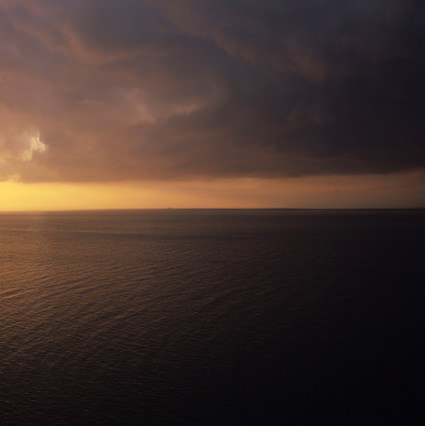
In 1976, aged just 19, the artist Garry Fabian Miller embarked on a body of work now known as Sections of England: The Sea Horizon, a series of photographs taken from the roof of Fabian Miller’s home at Clevedon, near Bristol, looking west across the waters of the Severn Estuary. Taken from this fixed point the lens, film and exposure remained constant, so that all that changes from picture to picture is time and the seasonal cycle. Each image is a simple square, divided precisely in half along the horizon.

In 1977 eight of these photographs were exhibited at the Serpentine Gallery in London and two years later they formed a principle element of Miller’s first one-man show at the Arnolfini in Bristol. For nearly 20 years, they then lay unseen until an enquiry from curators at the Metropolitan Museum of Art, New York, who realizing the increasing significance of this body of work, brought Miller’s early career back into focus.

Exhibition runs through till July 13th, 2013

Ingleby Gallery
15 Calton Road
Edinburgh
EH8 8DL
Scotland
www.inglebygallery.com


JULIÃO SARMENTO: 75 PHOTOGRAPHS, 35 WOMEN, 42 YEARS

Posted on 2013-06-03

Julião Sarmento: 75 Photographs, 35 Women, 42 Years brings together a large body of work that has never been shown in the UK. First exhibited at Vieira da Silva & Arpad Szenes Fundation in Lisbon, Portugal in 2010, the collection of images has been gathered from Sarmento’s extensive photographic archive by the curator Sérgio Mah. The selection of 75 photographs, taken by Sarmento from the late 1960s to early 2000, was based upon the common link of portraits of individual women.

The portrayal of the female form, normally faceless women or monochrome silhouettes, has been a major theme throughout Sarmento’s practice. However, the practice of portraiture has predominantly been associated with Sarmento’s photographic works. 75 Photographs, 35 Women, 42 Years not only depicts the female face, but the title of each image reveals the woman’s name and connects her to a time and place in Sarmento’s life. Collectively the portraits reflect upon relationships, especially the connection and dialogue between each woman and the artist. The candid shots capture personal and intimate exchanges, along with more impulsive and playful moments. In some of the photographs the preparatory and experimental nature of the shot alludes to Sarmento’s wider conceptual and aesthetic sensibilities.

Exhibition runs through till June 27th, 2013

Pilar Corrias Gallery
54 Eastcastle Street
W1W 8EF
London
UK

www.pilarcorrias.com


ESKO MANNIKKO & PEKKA TURUNEN – PEMOHT

Posted on 2013-05-27

The title takes its’ name from a photographic essay realised by the two artists in conjunction over a seven year period between 1989 and 1995. This significant series has been reassembled by the artists and can now be seen in its’ almost integrality. This will also be the first time both artists will be shown together in a gallery context.

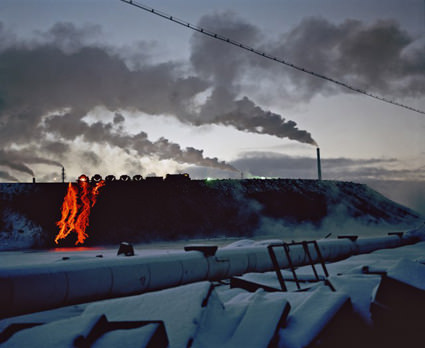
The title PEMOHT refers to the Cyrillic script for the Russian word Remont – a term which can be translated as reparation and stands as the euphemistic and tragic symbol for the collapse of a country and the subsequent failure of its’ institutions, devices and social structures. Within the immediate wake of the Soviet Union’s dissolution the two photographers travelled to the Kola Peninsula, a remote area on the border of northern Finland. At the beginning of the Soviet period the peninsula was heavily industrialised and militarised, largely due to its’ strategic position and the discovery of the vast nickel and heavy metal deposits in the 1920s. As a result, the ecology of the area suffered major ecological damage, including contamination by military nuclear waste and nickel smelting.

Set against the bleak backdrop of this violated area, Männikkö and Turunen’s colour photographs set out to document the everyday reality of a disenfranchised community living on the margins during times of major transition. A haunting document of post-Soviet living conditions, PEMOHT captures this new reality with poetry, clarity and grit.

Exhibition runs through till June 22nd, 2013

Galerie Nordenhake GmbH
Berlin Lindenstrasse 34
DE-10969
Berlin

www.nordenhake.com


NICHOLAS MUELLNER – THE NAUTILOID HEART

Posted on 2013-05-27

His projects investigate the limits of photography as a documentary pursuit and as an interface to literary, political and personal narratives.

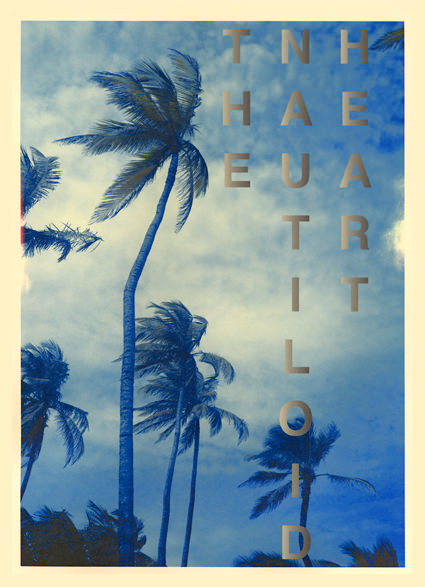
The Nautiloid Heart is a shipwrecked novel. Occasionally, its flotsam washes up on foreign shores: images, allegories and scraps of lore. In this exhibition of salvage from a vanished book, photographs and text fragments evoke this tropical-gothic tale, set on the tiny island of Little Corn, sixty miles off the coast of Nicaragua. Over the past 500 years, the island has been a Carib Indian way-station, a pirate hideaway, a hunting ground for Spanish and British sailors, an American coconut plantation, a Nicaraguan penal colony, a drug-runners’ haven and a beach retreat for backpackers.

Photographing on the island between 2009 and 2012, the artist asked: how does one document a landscape so subject to the vicissitudes of other peoples’ imaginations? The Nautiloid Heart is an incomplete fiction, set in a version of a real place. On a land defined by passing fancy, depiction and projection momentarily converge.

Exhibition runs through till June 24th, 2013

Noshowspace
13 Gibraltar Walk
London
E2 7LH

www.noshowspace.com


ANJA NIEMI – STARLETS

Posted on 2013-05-27

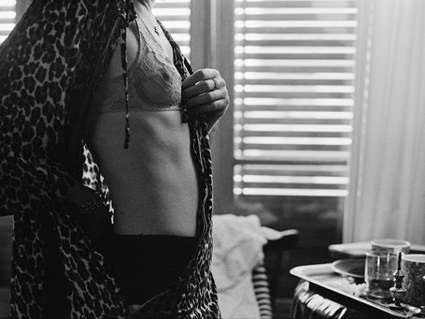
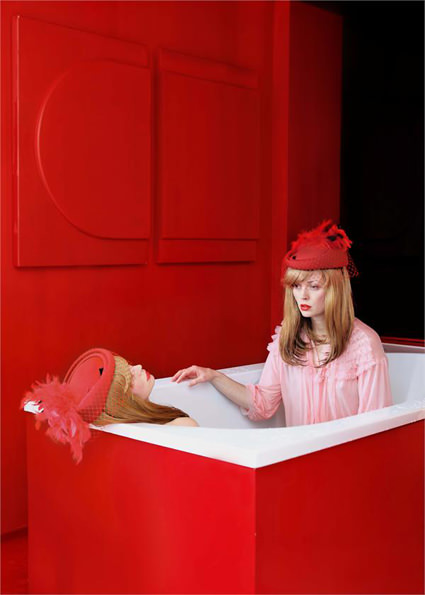
In Starlets, her latest series of photographs, exhibited for the first time, she continues to combine the self-portrait with the idea of the staged narrative. The images are like film stills or movie posters, with herself cast as the lead character. The stories are loosely told, leaving room for interpretation, and although it is mostly fiction, “there will always be a bit of me in them” she says. Unlike her previous series Do Not Disturb, where she purposely tried to distance herself from her everyday life in Norway, this time she photographed herself mostly close to home, in everything from landmark hotels, private homes and historic architectural houses, adding to the series a hint of her Scandinavian heritage.

The images possess an eerie, unreal quality, combining tragedy with humor. She uses a stylised language to create artworks that probe the false promise of perfection, suggesting that there is usually something hiding behind a flawless facade.

Born in Norway in 1976, Anja Niemi studied at London College of Printing and Parsons School of Design in Paris and New York. She has exhibited widely in both Europe and USA with her previous series ‘Do Not Disturb’, ‘Portrait of the Invisible’ and ‘Porcelain’.

Exhibition runs from June 4th to June 29th 2013

The Little Black Gallery
13A Park Walk
London
SW10 0AJ

www.thelittleblackgallery.com


TERRY EVANS – THE INHABITED PRAIRIE

Posted on 2013-05-20

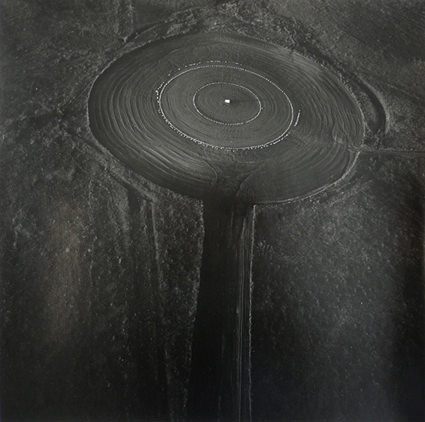
Inhabited Prairie, an exhibition of vintage black and white aerial photographs taken by Terry Evans between 1990 and 1994, which explore the complexities and contradictions in America’s heartland, specifically the artist’s local landscape in her native Kansas. This particular region has a deep and varied history of use. For instance, Smoky Hill Weapons Range, the nation’s largest Air National Guard bombing site, is contained within fertile fields and agro-industrial lands, and is only a short distance from the Tallgrass Prairie Natural Preserve, the last uncultivated tallgrass prairie ecosystem in North America.

Having photographed the ecology of the prairie floor from ground level for several years, Evans determined that the story of the land was incomplete without a macroscopic perspective of what she described as the “disturbed, cultivated, militarized” prairie.

In 1990, Evans began taking flights in a 25-mile radius around her home in Salina, Kansas, cataloguing the farms, flooded fields, cemeteries, ancient Indian village sites, highways, train tracks, bridges, military sites, cattle ranches and industrial gravel pits comprising the land below. Flying at 700 to 1000 feet, Evans could read specific pieces of visual information on the ground, without the entire landscape veering into abstraction. This distinction is critical to Evans’ practice, and it allowed for her unflinching look at the relationship between human intervention and the natural prairie. As Evans writes: “The thing I love the most was learning to read the landscape history from the air. I felt I was acquiring a sort of visual literacy of the ground. It was about reading the clues that told me whether or not the ground had ever been plowed, where the cemeteries were, what part was military, and what the history of all those markings meant.”

Exhibition runs through till July 3rd, 2013

Yancey Richardson Gallery
535 West 22nd Street 3rd floor
New York
NY
10011

www.yanceyrichardson.com