WAYNE MCGREGOR’S WOOLF WORKS STILL STUNS

Posted on 2026-01-28

Ten years on, this ambitious ballet remains one of the most compelling translations of literature into dance.

Woolf Works at the Royal Opera House draws you into Virginia Woolf’s world of luminous volatility, and drops you back quietly transformed.

Endlessly compelling for both her radical imagination and her troubled life, Woolf is a fitting muse for Wayne McGregor, another restless experimenter. His first full length ballet, which was first seen here in 2015, has returned like a glamorous, melancholic apparition. In the Words of Max Richter, “Wayne’s language and way of connecting to music has a unique grammar… it’s always very striking.”

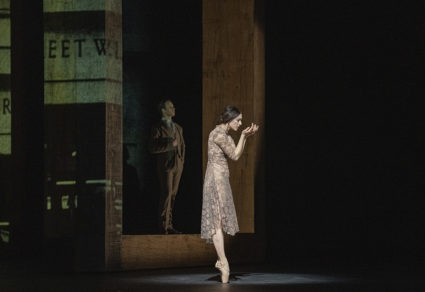
Woolf’s brilliance lies in her ability to describe the varied, multidimensional lives we lead. The opening section, I Now, I Then, drawing on Mrs Dalloway, explores memory, trauma and inner life. Huge moving frames slide across the stage, becoming portals between different versions of the self. Dancers pass through them like travellers crossing time zones. Natalia Osipova’s Woolf/Dalloway is restrained and fragile, shadowed by unease. Marcelino Sambé’s Septimus shatters, he’s twitchy and hollowed out, weighted by invisible wounds.

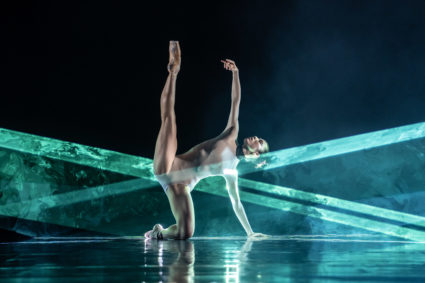
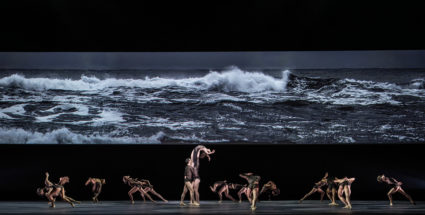
Then Becomings arrives and detonates the atmosphere. Inspired by Orlando, this is McGregor at his most untethered. Beams of turquoise light cut through the space, occasionally fractured by red, turning the stage into something between a sci-fi landscape and a lucid dream. Time loosens. Gender blurs. Storytelling politely steps aside. The movement is ferocious: extreme extensions, sudden sprints, bodies bending past expectation. The final section, Tuesday, brings everything inward. Here, the stage is dominated by a vast black-and-white film of the sea, endlessly rolling, impassive and immense. Silvers and blues wash over the dancers. The pace slows. The noise falls away.

Max Richter’s score runs through the evening like an emotional pulse: part symphony, part electronic landscape. Under Koen Kessels’s precise conducting, it binds the work’s beauty, restlessness, sorrow, and longing into a single current. As Richter has said, Woolf’s language is “a search tool, a way of probing what it means to be a person.” Visually, the production is meticulously composed. The sets by Ciguë and We Not I are spare but resonant. Lucy Carter’s lighting shapes feeling as much as space. Ravi Deepres’s films feel like projections of Woolf’s subconscious.

Rarely does a ballet think and feel with such force all at once, and rarer still, is one that stays with you in such a way.

Words – Celeste Aurora Mae

www.rbo.org.uk


MANFRED PERNICE – DIARY2

Posted on 2026-01-26

diary2 is a small group of works that complements and elaborates on diary (2008), composed of drawings, particleboard, Formica, empty cardboard boxes, plastic bag, varnish, metal rods, and wall paint. The drawings-reproductions of now-lost originals,trace the constructive development of the work and make visible its formal considerations. A related photographic series revisits the motifs originally used for the miniature book diary.⁠

Opposite – Reply, 2018

Exhibition runs through to February 28th, 2026

Anton Kern Gallery
WINDOW
91 Walker Street
10013 New York

www.antonkerngallery.com


TITUS KAPHAR – THE FIRE THIS TIME

Posted on 2026-01-26

The exhibition title refers to James Baldwin’s civil-rights-era masterpiece, The Fire Next Time (1963), which charts the author’s struggle with—and ultimate rejection of—the racial politics of America. In relocating to Paris, Baldwin joined a community of American expatriate artists and thinkers, including Miles Davis, Nina Simone, and Richard Wright—figures who refused what Baldwin called “the American madness.” Jesmyn Ward’s anthology The Fire This Time (2017) carries those concerns into contemporary America, more than fifty years later.

Kaphar’s new paintings and sculptures reflect on the symbolic role of the American presidency at a moment when that “madness” is again at center stage. As the United States approaches the 250th anniversary of the Declaration of Independence—alongside national “No Kings” protests—Kaphar offers a form of homage and redress by foregrounding faces and voices that have long existed in the shadows of power.

Opposite – Kinfolk, Breath is my Precious Inheritance (Sarah Johnson), 2025

Exhibition runs through to March 7th, 2026

Gagosian
4 rue de Ponthieu
75008 Paris
France

gagosian.com


THOMAS HUTTON – NIGHT HERON

Posted on 2026-01-26

Thomas Hutton grew up in rural north Wiltshire. He completed an MA (hons) in architectural history at the University of Edinburgh (2002-6) before receiving a scholarship to study sculpture at Yale University (2010-12). At Yale he took several classes in the architecture department, notably with Peter Eisenman who helped turn his attention to Rome. His work is often characterized by an intense commitment to materials and research, that often define where he lives and works.

Opposite – Spellmann Shoemaker, 2025

Exhibition runs through to February 14th, 2026

Sylvia Kouvali
41 Polidefkous
18545 Piraeus
Greece

www.sylviakouvali.com


ACHILLE PERILLI

Posted on 2026-01-19

The exhibition presents a selection of works by Achille Perilli belonging to the cycle that, beginning in the late 1960s, marks one of the most concentrated and continuous phases of his research. To fully grasp its scope, it is essential to recall the context from which it emerged: the experience of Forma 1, co-founded by Perilli in 1947, which initiated a sustained reflection on form as a dynamic process and on space as a conceptual dimension, never conceived as a mere support or representational field.

Within this framework, form is understood as a condition of permanent tension and transformation, a premise that underpins the artist’s subsequent developments. At a moment defined by the crisis of traditional perspectival systems, Perilli articulated a rigorous theoretical position, set out in his text Indagine sulla prospettiva (1969). Perspective is questioned as a coercive device of vision and replaced by an unstable structure based on the interaction of color, line, tone, and form. The work thus renounces the presentation of a legible image or identifiable space, reducing visual information to the point of becoming an open, ambivalent experience, devoid of definitive resolution.

Opposite – La forma bella, 1948

Exhibition runs through to February 28th, 2026

Alfonso Artiaco
Piazza dei Martiri 58
80121 Napoli
Italy

www.alfonsoartiaco.com


ERIK BULATOV – HOMMAGE

Posted on 2026-01-19

Following the passing of Erik Bulatov, SKOPIA present Hommage, a tribute to the artist. On this occasion SKOPIA will display paintings, some that were never shown at the gallery.

Opposite – Greece, 1996

Exhibition runs through to February 28th, 2026

SKOPIA
Vieux-Grenadiers 9
1205 Geneva
Switzerland

skopia.ch